.png)
Quality Management in Egyptian Auditing Standards
The updated Egyptian Standards on Auditing introduce a significant paradigm shift from traditional quality control to a comprehensive quality management approach. Under the new regulations, audit firms operating in Egypt are mandated to establish, implement, and maintain robust firm-wide quality management systems. This responsibility squarely falls on the firm’s leadership, including the chief executive or managing board, to foster an internal culture that prioritizes quality in every engagement. These systems must be thoroughly documented and designed to proactively identify and mitigate risks to audit quality before they impact financial disclosures. By focusing on firm-level governance, resource allocation, and continuous monitoring, this standard ensures that all statutory audits conducted within the Egyptian market uphold the highest levels of professional integrity, independence, and regulatory compliance.
....jpeg)
Key Audit Matters in Egyptian Auditing Standards
introduction of the Key Audit—Key Audit Matters representation is a significant enhancement to the auditor's report for listed entities. This standard mandates auditors to identify and disclose those issues that, in their professional judgment, were of most significance in the audit. These matters typically involve complex estimates, significant management judgments, or areas of high estimation uncertainty. By providing clear descriptions of these matters and how they were addressed during the audit, the report offers valuable insights to investors and stakeholders, significantly increasing the transparency and communicative value of the audit process within the Egyptian financial market.
...
Impairment of Financial Instruments in Egyptian Accounting Standards
The adoption of the impairment model in Egyptian accounting regulations fundamentally alters how companies recognize and measure credit risk on financial assets. This standard shifts the focus from an incurred loss approach to a forward-looking expected credit loss model, requiring entities to evaluate potential impairment losses continuously from the point of initial recognition. Companies must assess macroeconomic factors and historical data to estimate the probability of default, ensuring financial statements reflect a realistic view of the entity's exposure to credit risk.
....jpeg)
Revenue Recognition from Contracts with Customers
The standard on revenue recognition in Egyptian accounting regulations provides a comprehensive, principle-based framework for recognizing revenue. It replaces multiple legacy standards with a single, uniform five-step model designed to depict the transfer of promised goods or services to customers in an amount that reflects the consideration the entity expects to be entitled to in exchange for those goods or services. This approach requires companies to identify the contract, identify the performance obligations, determine the transaction price, allocate the transaction price to the performance obligations, and recognize revenue as those obligations are satisfied.
...
Leases in Egyptian Accounting Standards
. The standard on leases in Egyptian accounting regulations introduces a comprehensive model for the identification, recognition, measurement, and disclosure of leases. It eliminates the traditional classification of leases as either operating or finance leases for lessees. Instead, the new standard requires lessees to recognize assets and liabilities for all leases with a term of more than twelve months, unless the underlying asset is of low value. This single, on-balance sheet lease accounting model enhances transparency by requiring companies to recognize right-of-use assets and lease liabilities, thereby providing a more accurate representation of their financial obligations and commitments.
....jpeg)
Financial Reporting in Hyperinflationary Economies under Egyptian Accounting Standards
The standard governing financial reporting in hyperinflationary economies ensures that companies maintain the relevance and comparability of financial statements when the local currency loses purchasing power rapidly. When an economy is deemed hyperinflationary, the financial statements of an entity must be restated using a general price index to reflect the changes in general purchasing power. This standard outlines the specific criteria for identifying such economies and details the rigorous methodology required to adjust historical costs and non-monetary items. By converting past figures into current monetary units, the financial reports present a truthful and meaningful representation of the entity’s financial performance and position despite prevailing inflationary pressures.
....jpeg)
Foreign Exchange and Exchangeability Management under Egyptian Accounting Standards.
The standard regarding foreign currency transactions in Egyptian accounting regulations provides a comprehensive framework for the recording, measurement, and disclosure of foreign currency elements. It dictates that foreign currency transactions should be initially recorded at the spot exchange rate between the functional currency and the foreign currency at the date of the transaction. At the end of each reporting period, monetary items are translated using the closing rate, and any resulting exchange differences are recognized in the income statement. The standard highlights management's responsibility to assess and manage currency risks, particularly in environments characterized by volatility or restricted exchangeability, ensuring that financial statements transparently reflect the financial impact of currency fluctuations. The standard regarding foreign currency transactions in Egyptian accounting regulations provides a comprehensive framework for the recording, measurement, and disclosure of foreign currency elements. It dictates that foreign currency transactions should be initially recorded at the spot exchange rate between the functional currency and the foreign currency at the date of the transaction. At the end of each reporting period, monetary items are translated using the closing rate, and any resulting exchange differences are recognized in the income statement. The standard highlights management's responsibility to assess and manage currency risks, particularly in environments characterized by volatility or restricted exchangeability, ensuring that financial statements transparently reflect the financial impact of currency fluctuations.
....jpeg)
Corporate Income Tax Regulations for Foreign Entities in Egypt.
The Egyptian tax framework imposes specific obligations on foreign entities operating within the country, primarily governed by the Income Tax Law. Foreign corporations are generally subject to taxation on income derived from Egyptian sources, including profits attributable to a permanent establishment. The determination of taxable income involves adjusting accounting profits for non-deductible expenses and recognized tax exemptions. Furthermore, the regulations mandate strict compliance with transfer pricing guidelines to ensure that transactions between related parties are conducted at arm's length. Understanding these corporate income tax rules is essential for foreign investors to ensure full regulatory compliance and to optimize their tax positions within the Egyptian jurisdiction.
...
Investment Incentives for Foreign Investors in Egypt
To attract foreign direct investment, the Egyptian Investment Law provides a range of fiscal and non-fiscal incentives tailored to strategic sectors. These incentives typically feature special deductions from taxable net profits, calculated as a percentage of the investment cost, and are governed by defined geographical zones. Additionally, qualified projects may benefit from reduced customs duties on imported machinery and equipment, streamlined licensing procedures through the Golden License framework, and full guarantees for the repatriation of profits. These regulations are designed to enhance the operational feasibility and profitability of international firms establishing a presence in the Egyptian market.
...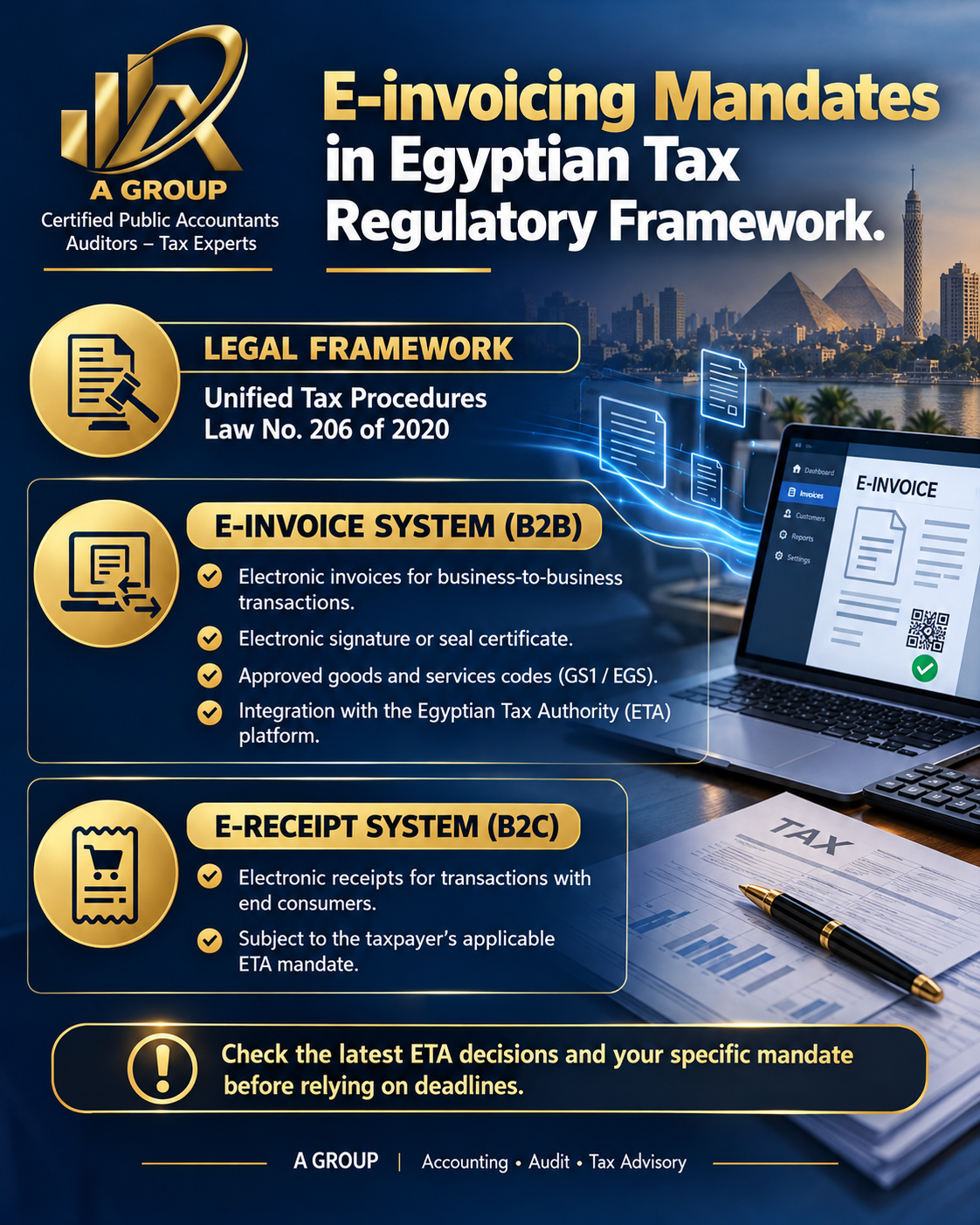
E-invoicing Mandates in Egyptian Tax Regulatory Framework.
The Egyptian Tax Authority has progressively implemented mandatory electronic invoicing for all business-to-business transactions, replacing traditional paper invoices. This digitized system requires businesses to generate, submit, and validate tax invoices in real-time through a centralized portal. The implementation of mandatory e-invoicing is a cornerstone of the government's fiscal reform strategy, designed to enhance tax compliance, reduce tax evasion, and integrate the informal sector into the formal economy.
...